
AI Voice Agents in 2026: How Businesses Are Turning Websites Into 24/7 Sales Assistants
A website used to be a digital brochure.
Today, it can become something much more useful: an interactive AI assistant that can answer questions, explain products and services, qualify visitors, and help businesses capture leads—even when nobody is available to respond.
This is where AI voice agents and AI website agents are becoming increasingly interesting for businesses.
Instead of forcing visitors to search through pages, read FAQs, or wait for a sales representative, an AI agent can communicate with them directly.
What Is an AI Voice Agent?
An AI voice agent is an artificial intelligence system that can communicate with people through natural speech.
Unlike a traditional chatbot that requires users to type questions, a voice agent allows visitors to simply speak.
For example:
“Do you deliver in Ahmedabad?”
The AI can understand the question, retrieve relevant information, and respond naturally.
A more advanced agent can also understand follow-up questions:
“How much does it cost?”
“And how long does delivery take?”
“Can someone contact me tomorrow?”
This makes the interaction feel much closer to speaking with a real business representative.
Why Are Websites Becoming Interactive?
Most business websites still work in the same way:
- A visitor arrives.
- They browse pages.
- They look for information.
- They find a contact form.
- They submit their details.
- Someone from the business contacts them later.
The problem is that every additional step creates friction.
Visitors may leave the website before finding the information they need.
An AI website agent changes this interaction.
Instead of making the visitor find the answer, the website can bring the answer to the visitor.
Traditional Website
Visitor → Pages → Search → Contact Form → Wait
AI-Powered Website
Visitor → Ask → AI understands → Answer → Lead captured
The difference is small from a technical perspective but significant from a user-experience perspective.
What Can an AI Website Agent Do?
A modern AI agent can be trained using the information already available to a business.
This can include:
- Website pages
- FAQs
- Product information
- Service descriptions
- Documentation
- PDFs
- Pricing information
- Company information
- Policies
- Other business knowledge
Once the information is available to the AI, visitors can interact with it conversationally.
For example, imagine a pharmaceutical company website.
A visitor could ask:
“What products does this company manufacture?”
Then:
“Do you provide private-label manufacturing?”
And finally:
“I want to discuss a bulk requirement.”
The AI can answer the informational questions and then move the conversation toward lead capture.
AI Voice Agents Are More Than Chatbots
A traditional chatbot generally focuses on text conversations.
Voice agents introduce another layer: real-time communication.
A visitor can speak naturally instead of typing.
This can be especially useful for businesses where customers frequently ask questions over the phone.
Think about industries such as:
- Real estate
- Healthcare
- Education
- Hospitality
- Automotive
- Travel
- Professional services
- Manufacturing
- E-commerce
- Local businesses
The common factor is simple: customers have questions before they make a decision.
An AI agent can become the first layer of interaction.
The Real Opportunity: Lead Qualification
One of the most interesting applications isn't simply answering questions.
It is understanding intent.
Imagine someone visits a website and says:
“I'm looking for a website for my manufacturing company.”
Instead of simply replying with generic information, an AI agent can ask useful follow-up questions:
“What type of manufacturing business do you operate?”
“Do you already have a website?”
“What services would you like the website to include?”
“What is the best way to contact you?”
The conversation can then become a qualified business lead.
This is where AI agents start becoming more than customer-support tools.
They become part of the sales process.
AI Agents Can Work 24/7
A human sales representative cannot realistically answer every website visitor at every hour.
An AI agent can.
Someone visiting a website at:
11:30 AM
or
2:00 AM
can still receive an immediate response.
This doesn't mean AI should replace human sales teams.
Instead, it can handle the first layer of interaction and pass important conversations to humans.
A simple workflow could look like:
Visitor → AI Agent → Understand Requirement → Qualify Lead → Human Sales Team
The human team can then spend more time on conversations that actually require human involvement.
Building an AI Agent for a Website
The technical architecture behind a website AI agent can be surprisingly straightforward.
A simplified system looks like this:
                 WEBSITE VISITOR
                        │
                        ▼
                AI CHAT / VOICE UI
                        │
                        ▼
                 AI AGENT ENGINE
                        │
              ┌─────────┴─────────┐
              ▼                   ▼
        Knowledge Base        Conversation
              │                   │
              ▼                   ▼
      Website / PDFs / FAQ    User Intent
              │                   │
              └─────────┬─────────┘
                        ▼
                  AI RESPONSE
                        │
                        ▼
                 LEAD / ACTION
The knowledge layer provides the business information.
The AI model processes the visitor's question.
The agent then generates a response based on the available business knowledge.
Why Grounding Matters
One of the biggest challenges with AI is hallucination.
An AI model may know a lot about the world, but it doesn't automatically know the latest information about a specific company.
For example, if a company has three services listed on its website, the AI shouldn't invent a fourth service.
This is why business AI agents need a reliable knowledge source.
The agent should be grounded in information such as:
- Official website content
- Company FAQs
- Uploaded documents
- Product catalogs
- Internal knowledge
This creates a much more controlled experience.
AI Voice + AI Text
Businesses don't necessarily have to choose between voice and text.
Both interfaces can exist together.
For example, a website could provide two options:
Chat with AI
or
Talk to AI
Text can be useful when someone wants to copy information, compare products, or browse quietly.
Voice can be useful when someone wants a faster, more natural conversation.
Providing both gives visitors more control over how they interact with the business.
Where Vaizent Fits
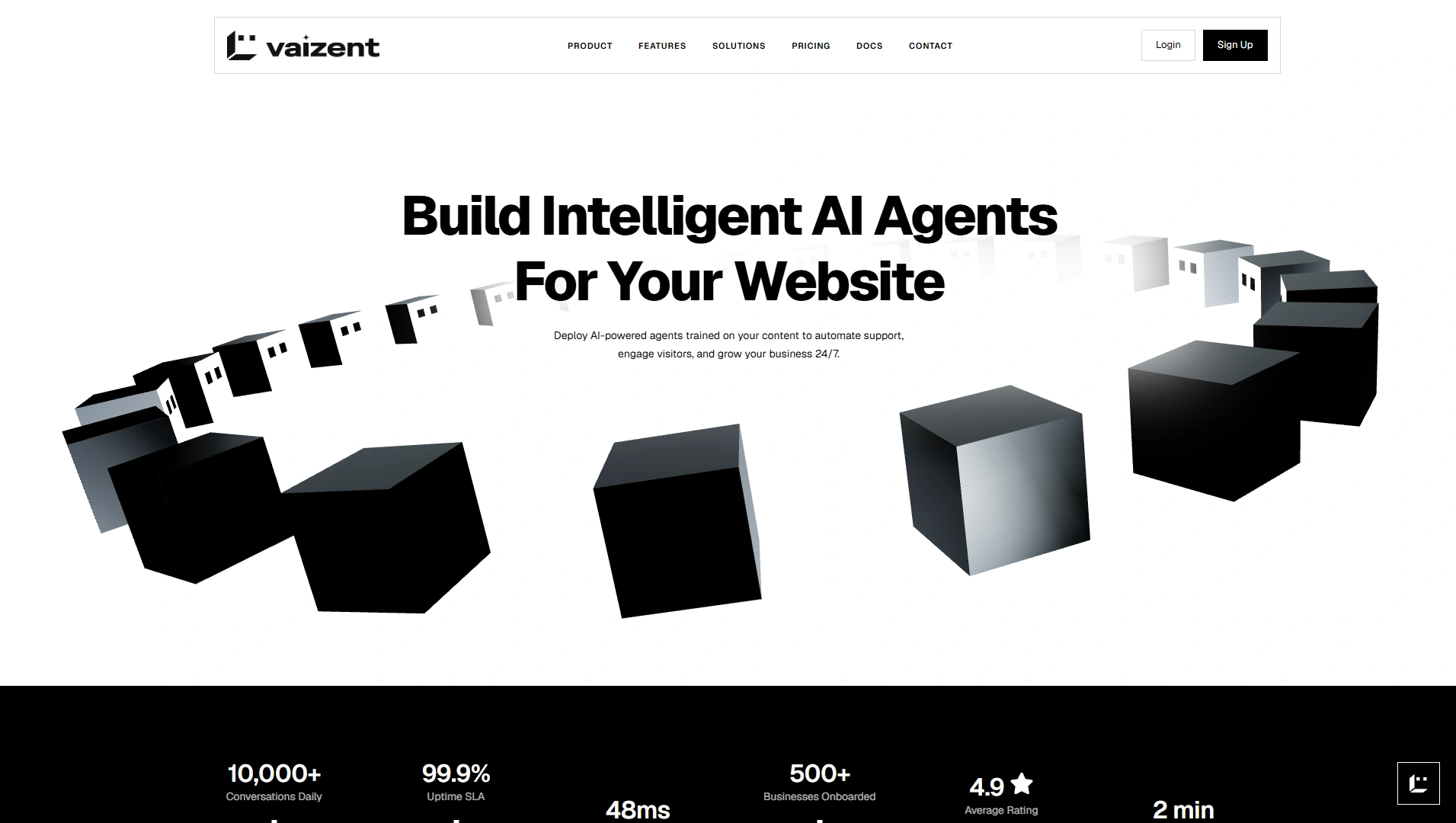
This is the idea behind Vaizent.
Vaizent is designed around turning a business website into an interactive AI agent.
Instead of simply embedding another static widget, businesses can give their websites an AI-powered layer capable of answering questions, interacting with visitors, and helping capture leads.
The broader idea is simple:
Your website shouldn't just display information. It should understand your visitors.
A business can provide its website content, FAQs, documents, and other information to create an AI-powered experience around its existing website.
The result is a website that can communicate instead of simply presenting information.
What Happens Next?
AI agents are moving websites from static experiences toward conversational interfaces.
The next generation of business websites may not be defined only by beautiful design.
They may also be defined by how well they can communicate.
A visitor shouldn't always have to search through ten pages to find an answer.
They should be able to ask.
And the website should be able to respond.
That's the shift from:
Website → Information
to:
Website → Conversation
And AI voice agents are one of the technologies making that transition possible.
Final Thoughts
AI voice agents aren't just another version of chatbots.
They represent a broader change in how people interact with businesses online.
Instead of navigating menus, searching pages, and filling out forms, customers can increasingly communicate with a business naturally.
For businesses, that creates an opportunity to make websites more useful, more responsive, and more capable of turning conversations into meaningful leads.
The website of the future may not simply answer the question:
“What does your business do?”
It may also answer:
“How can I help you?”